
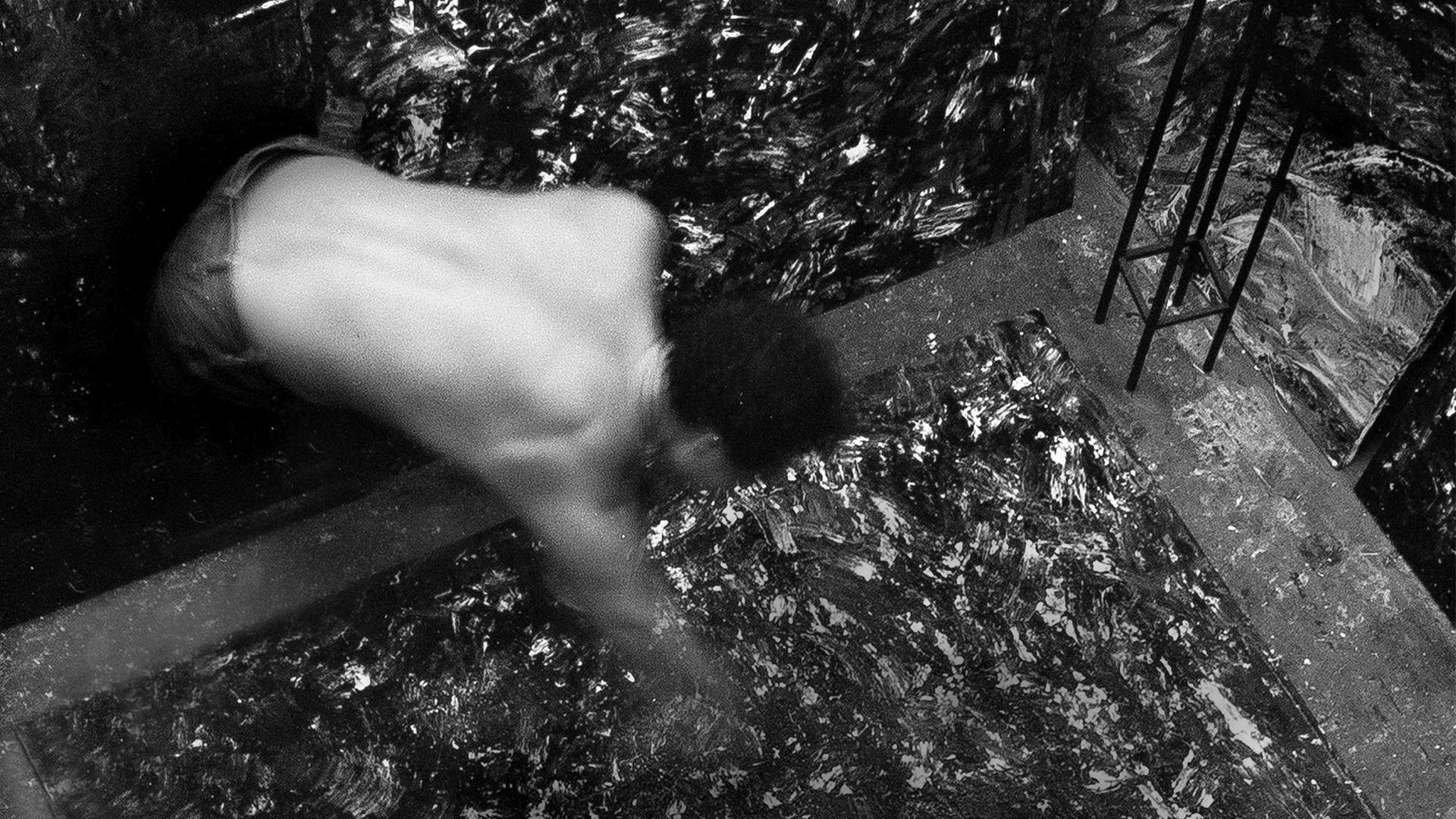
This exhibition takes us on a half-century journey through the work of Dionisio Gázquez, a painter who has turned abstraction into a language of his own. His career does not follow a straight line: his series overlap or come to a pause only to reappear decades later with a new purpose. The exhibition provides an account of how Gázquez’s work has evolved over time, highlighting the notions the artist has been concerned with from the outset: light, matter, space and gestures.
Early career and connection with the artist’s latest works
In his Obras tempranas [“Early works”] (1973-1976), Gázquez employs random strokes in which abstraction emerges before the painting is finished. Alongside this series, the Dibujos [“Drawings”] he created in the 1970s and 1980s lay the structural foundations of many of his future ideas. The photographs in the Abstracciones en el muro [“Abstractions on the wall”] series focus on ruined walls and spaces to reveal textures that have already become paint. For its part, the Energy series – initiated in the mid-1970s and resumed in the 2000s – accurately reflects the way in which Gázquez revisits past works, closing a creative circle that we can examine at the end of the exhibition.
The 1980s
Cromatismos [“Chromatism”] marked the beginning of the decade, of those years of newfound freedom in which, in a return to painting, colour and composition take centre stage. But Gázquez’s palette would soon grow darker. In Presencias [“Presences”], shapes arise from the shadows; Verticalidad [“Verticality”] conveys a yearning for light and the sublime. Dualidades [“Dualities”] explores the tension and contrast between textured planes. The interplay between opposites (light and shadow, gesture and structure) is a hallmark of his work. The bold compositions included in Vital impetus are reminiscent of action painting.
Maturity
The large-size works that make up Bosque interior [“Inner forest”], executed in the late 1980s and during the 1990s, are Gázquez at his most personal. His thick webs of strokes evoke landscapes as well as an intimate space. Visitors would do well to read the title of each piece, resembling lines of poetry that give us perspective without excluding alternative interpretations. Taking painting to a spatial dimension, Ámbitos [“Settings”] (1991-1993) is an installation in which painted motifs are reflected, remaining in suspension within the room. The artist’s Esculturas [“Sculptures”], from 1994, are best described as spatial structures with musical undertones.
The 2000s
That lyrical quality became less prominent in Dripping / Texturaciones. Employing grids and linear rhythms of colour, Gázquez paid tribute to Mies van der Rohe, Mondrian, Rietveld and Sempere. Espacios de luz [“Spaces of light”] (1973/2025) delved into his constant search, guided by a certain notion of architectural space: cuts and tears in the surface that let us glimpse a vibrating colour from the depths of the painting. Be sure to get closer and observe these pieces as you move sideways – you will find that they change when viewed from different angles.
Other gazes
Taken during the pandemic in 2021, Gázquez’s Fotografías [“Photographs”] show abandoned industrial buildings illuminated by light beams, again reflecting his interest in architecture and matter. We reach the end of the exhibition with El tiempo pasa [“Time passes”] (1968/2026), a series of small self-portraits that have accompanied the painter throughout his life.
All in all, Gázquez’s career can be summed up as a tireless quest to challenge the boundaries of abstraction, matter and poetry.
Enric Mira, curator